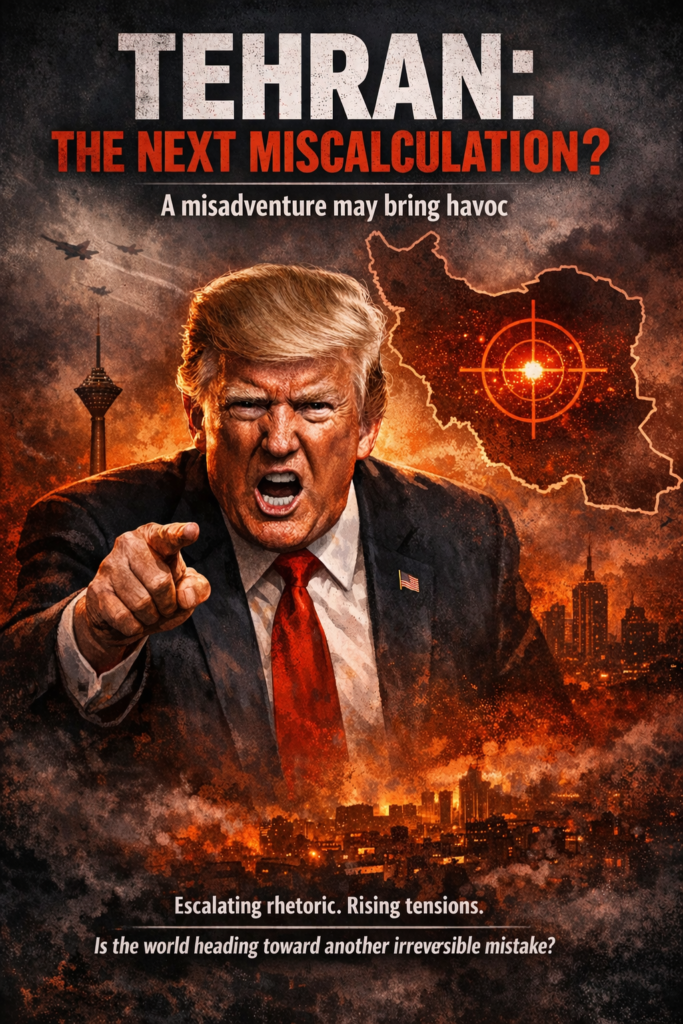
Failures in war do not only occur during a conflict; they often come right after the combat has ended. The United States has shown, on several occasions, tremendous military capabilities but still lost the war (or achieved very little) in Vietnam, Libya, Iraq, and Afghanistan, the U.S. did not produce a lasting politically stable system and did not help produce a good government when it left those countries. An important factor behind these debacles was its repeated and continual misreading/misinterpretation of the political dynamics and power balance among the various groups within the targeted countries, specifically related to identity and ethnicity. The current tensions or hostilities between the U.S. and Iran indicate that the same misinterpretation may be repeated regarding Iran.
Modern warfare doesn’t just destroy an enemy’s military capacity but rather disrupts the entire political ecosystem in which the state exists. There’s a complicated web of institutions, elites, informal authorities, and long-standing shared concepts, of what it means to be part of a nation that supports a state. When outside actors intervene without understanding the underlying political structures, they tend to destroy only the overt manifestations of statehood, without addressing the underlying political forces.
According to Amy Chua, the United States failed at establishing democracy in Vietnam because they tried to impose their style of democracy upon the different people, ignoring ethnic and tribal divisions in Vietnam. Additionally, by propping up a corrupt, minority-favoring elite, the United States alienated most of the people who lived in rural areas, which in turn increased the Viet Cong’s support and helped create instability in Vietnam. Despite learning the lesson from this misadventure, the US followed similar patterns in their future endeavors.
The experience of the United States in Iraq provides us yet another example. The removal of Saddam Hussein from power was achieved in 2003 quickly, but the U.S. government’s decision to dismantle the Baathist political organization and disband of the Iraqi military disregarded the deeply embedded structures of governance and identity within the society. The U.S. intervention, rather than forging a democratic political system, created a power vacuum that exacerbated sectarian conflict and insurgency. Meanwhile, the Iraqi state reasonably recreated itself, but only after many years of instability and violence that transformed the region.
In Afghanistan, the same misjudgment was made as in the past, by assuming that, Afghanistan was a unified state. This central idea is not true; it is much more complicated than one of a unified state. The Taliban were able to maintain their existence due to their ability to insert themselves into the local power structures, by the ideological and physical means. Even after 20 years of military intervention from, the superpower failed to find a way to install the type of regime it wanted. When the United States pulled out of Afghanistan in 2021, the political system that had been created fell apart very quickly.
The pattern of blindness about the social structure, was also apparent in NATO’s operation under the leadership of the USA in Libya and had a predictable result. The removal of Muammar Gaddafi during the 2011 did not consider the delicate balance of power between tribal, regional and militia entities, that held Libya together. As a result, Libya was divided into many competing local authorities, militias and foreign proxies, which created widespread instability across North Africa, rather than providing an opportunity for democratic change.
A misconception, that change of the regime is synonyms of changing the political system, has remained a flawed hallmark of American strategy during their military interventions. While military action can help eliminate specific leaders from power, it does not destroy the roots of political structure of society.
The current conflict with Iran bears much resemblance to the past American dealings with Iraq, Afghanistan and Libya. Before making any hasty conclusions about Iran, it is important to recognize, that unlike other previous nations, Iran does have a rich history of civilization as well as a strong sense of national pride. This pride has existed long before the establishment of what we refer to as the Islamic Republic of Iran. It is rooted in a powerful historical connection that can be traced back to the Persian Empires.
The external characterization of Iran’s political order tends toward a simple ideological construct, dominated by clerical power. However, the reality is much more complex, as there exists an elaborate hybrid arrangement of components, that include religious legitimacy, national sentiment, bureaucracy, and a strong military presence (namely the IRGC). The Iranian structure does not simply provide support for the ruling elite, but it is part of Iran’s overall national identity.
Donald Trump’s assumption, that military pressure alone will lead to the collapse of Iran’s current political order, may prove to a grave risk. Iran’s strength isn’t just about its military capabilities and its regional proxies, but also about a deeply rooted political identity consisting of a unique combination of nationalism, a revolutionary ideology, and institutional resilience.
Although, Iran remains vulnerable to pressures from within. Ongoing economic issues, opposition between opposing political factions and different generation attitudes can all affect Iranian society. However, the basis for these internal changes, as stated above, cannot easily be imposed using outside forces. There is a strong possibility that efforts to bring about a more rapid political transformation via military means may strengthen the existing structures, that the US is trying to destroy.
The main takeaway from this is that having a strong military force does not guarantee the success of political objectives. Lasting political change requires a much deeper understanding of how authority flows within society, creates legitimacy, and how the national identity influences the masses to collectively respond to external aggression.
After the second world war the United States has tried to resolve conflicts primarily by using military might through employing the concept of tactical superiority with technology and decisive attacks as first options. All wars are at their core political in nature but also are part of a larger societal context. Therefore, without having a good understanding of that societal context, there is a high risk of creating unintended consequences even with the most overwhelming military force.
The United States has had this experience in each of Baghdad, Kabul, Tripoli and Hanoi. It is yet to be determined whether it will once again experience this same lesson in Tehran.