
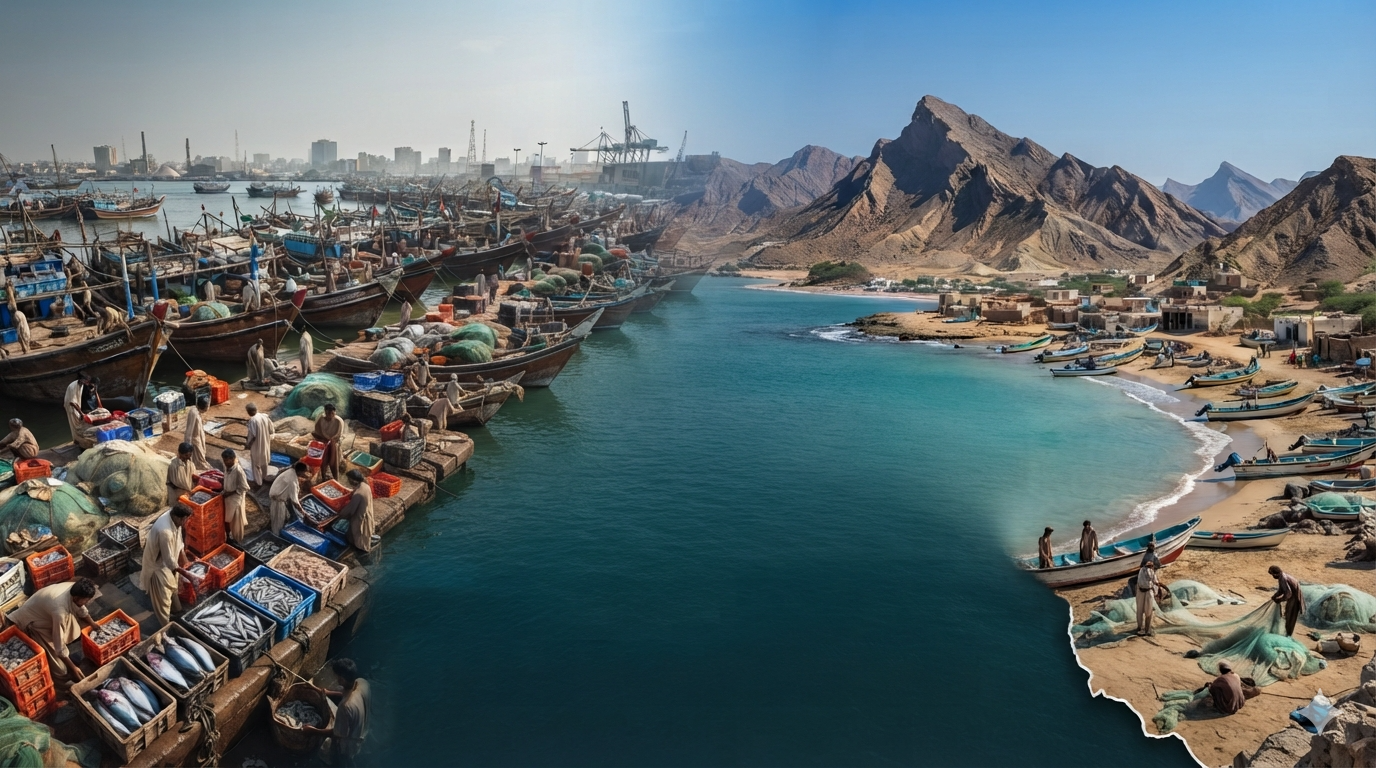
Part I: The Karachi Divide — A Governance Impasse in Plain Sight
Within a radius of barely twenty kilometres along Karachi’s coastline, two fisheries harbours operate under entirely different constitutional masters. The Karachi Fisheries Harbour Authority is a provincial body of the Government of Sindh, which manages the Karachi Fish Harbour at Keamari, through which more than 90 percent of the fish and seafood catch and export of Pakistan transits. Korangi Fish Harbour at Chashma Goth, Korangi District, is under the administration of the Federal Ministry of Maritime Affairs, Government of Pakistan. Same city. Same coastline. Same fishing industry. Two different governance systems, two different budgetary processes, two different regulatory systems, two different political agendas, and over a decade of disagreement over jurisdiction issues after the passing of the 18th constitutional amendment.
This bifurcation is not merely an administrative curiosity. It’s a governance issue that directly impacts Pakistan’s fisheries exports, coastal community wellbeing, food safety certification, blue economy growth and the efficient implementation of international maritime and fisheries standards. With the vision of aquaculture exports earning USD 1.5 billion per annum as per the Uraan Pakistan Blue Economy framework, it is high time we ask one question that has been put on the back burner for too long: Is Pakistan’s split fisheries harbour governance fit for purpose? The straight answer is no.
The governance split has rational historical roots, although it is increasingly irrational to continue it. Karachi Fish Harbour was built by the Federal Government in 1959. The 1973 Constitution of Pakistan made fisheries a topic of provincial concern, and thus, in 1974, the Karachi Fish Harbour was transferred to the Sindh government. Subsequently, the Karachi Fisheries Harbour Authority (KFHA) was established under Sindh Ordinance No. II of 1984 in response to the receipt of a huge grant from the European Economic Community (EEC) to upgrade the harbour. They have been administering the facility ever since.
Korangi followed a different trajectory. The Korangi Fisheries Harbour Authority (KoFHA) was formed under Ordinance No. XVI of 1982 for making all arrangements for planning, construction, operation and maintenance of the Korangi Fisheries Harbour for the exploitation of fisheries resources beyond Territorial Waters. It was the federal government’s justification for retaining administrative control, for this purpose-specific mandate, deep-sea fishing outside territorial waters. The EEZ, which is 200 nautical miles away from the baseline, was and continues to be a federal domain under UNCLOS and the Pakistan Exclusive Economic Zone (EEZ) Act. The federal argument is that a harbour constructed for deep-sea fishing operations within the EEZ, irrespective of its location in Sindh, was essentially federal infrastructure.
This argument had legal coherence in 1982, but over the last four decades, its coherence has increasingly been weakened.
The 1973 Constitution includes fisheries, specifically marine fisheries, in the Provincial Legislative List within the territory of a province, & Ports and port authorities are listed in the Federal Legislative List (Part I). The Constitution’s Fourth Schedule establishes a legislative architecture in which fisheries governance is a provincial matter, whereas maritime trade infrastructure, including major ports, retains a federal character.
The 18th Constitutional Amendment of 2010 further exacerbated this division by removing the Concurrent Legislative List completely and assigning all remaining subjects to the provinces and by closing the federal Ministry of Livestock and Dairy Development. Pursuant to the 18th Amendment, on paper, the Korangi Fish Harbour Authority and deep-sea resources are to be handed over to the Sindh government. This constitutional stance has been forcefully advocated by the Sindh government & Sindh’s Fisheries and Livestock department is pleading that under the 18th Constitutional Amendment, it is the provincial government which has rights over the Korangi Fish Harbour, but the federal government has been avoiding handing it over to Sindh.
The federal government’s counterargument is that deep-sea fishing in the EEZ is a federal issue, since the EEZ is not a provincial subject. This, although it is constitutionally justifiable, is politically and administratively twisted: a harbour in Sindh, serviced by Sindhi fishermen, linked to the urban infrastructure of Karachi, and having access to the labour market and services system of Sindh, being managed as a federal enclave, because the fish it processes are caught beyond a certain nautical mile in the sea. The result is a constitutional deadlock that serves neither entity well and is even less desirable to the fishing industry.
As a result, the institutional framework regulating fisheries for Karachi is fragmented. KoFHA is under the administration of the Ministry of Maritime Affairs, which is also responsible for the deep-sea fishing policy & EEZ. Attached to MoMA is the federal Marine Fisheries Department (MAFDE), which carries out marine fisheries research, issues licenses and regulates marine fisheries in the EEZ. Fisheries in the territorial waters are under the regulation of the Government of Sindh under the Fisheries Department, and the Karachi Fish Harbour is managed by Karachi Fisheries Harbour Authority. Further, Sindh’s Environment Protection Agency has the environmental regulatory jurisdiction over both the harbour facilities, placing a layer of provincial oversight on top of the federal government.
Part II: The Makran Coast — Gwadar & Pasni
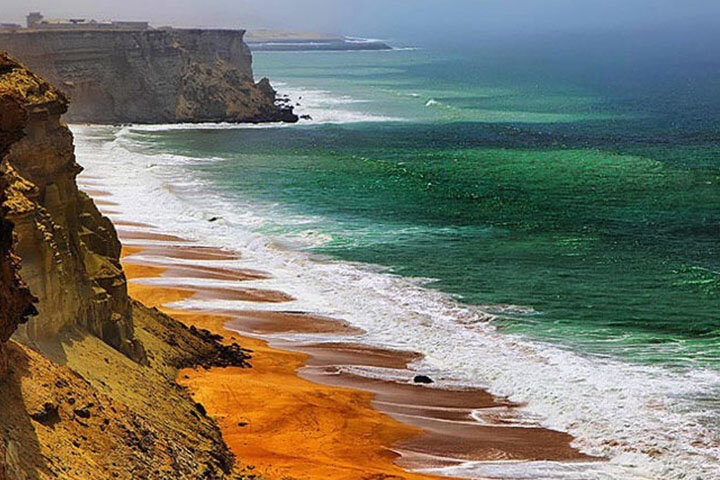
If the governance issue in the fisheries harbours of Karachi is a managed impasse, then the governance issue in Gwadar and Pasni Fish Harbour along the Makran coast of Balochistan can be termed as a Structural Deficit of even greater magnitude, and one that is on the back burner of the policy makers.
Gwadar Fish Harbour is a federal asset and is part of the Gwadar Port Authority (GPA), which is a federal entity under the Ministry of Maritime Affairs governed by the Gwadar Port Authority Ordinance, 2002. The harbour caters for the seafood landing, processing and export activities of the about 100,000 fishing community of Gwadar and the entire Makran coastal belt, which fetches seafood, mainly shrimp, cuttlefish, lobster and finfish, from the abundant but over-fished waters of the Northern Arabian Sea.
Theoretically, the mandate of the GPA also includes the Gwadar Fish Harbour. In practice, GPA, MoMA, Balochistan Fisheries Department, Balochistan Development Authority, and Gwadar Development Authority have overlapping mandates, unclear financial divisions and inconsistent policy directions. The fishermen from Gwadar are under the control of the Balochistan Fisheries Department, but the port facilities they use are federal assets, which are run by a port authority whose main job is to manage the commercial port and not fisheries. Such a gap between the administration of the harbour and the management of fisheries creates the institutional void that is exploited by IUU fishing, poor quality controls and low investment in processing facilities.
The CPEC dimension adds yet another layer of complexity. The port area of Gwadar has been declared the hub of the China-Pakistan Economic Corridor’s maritime leg, a port of the future, a free trade zone and an industrial city. The Gwadar Fish Harbour is located in this development zone, and the issue is whether the fishing community will be able to access their harbour or whether they will be displaced or their access will be improved during the subsequent commercialization of the port. Increased intensity of the development of CPEC has created unrest in the fishermen of Gwadar over restrictions on access to the port, a concern that is indicative of the overall lack of integration of the fishermen’s community interests in the planning process of CPEC. Presently, there has been no joint federal-provincial fisheries protection plan for the Gwadar fishing community published.
Let’s analyse the Pasni Fish Harbour, which is a provincial jurisdiction and a federal indifference. Pasni Fish Harbour, located approximately 200 kilometres west of Karachi at the town of Pasni in Gwadar District, presents a contrasting institutional picture. The Pasni harbour is not under the control of a port authority like Gwadar harbour. It is managed by the provincial Balochistan Fisheries Department, while infrastructure-related financing is channelled historically through the federal government Fisheries Development Board at the federal level, which has now been reduced after devolution of fisheries to provinces under the 18th amendment.
The result is a harbour that is neither fully federal nor fully provincial in terms of funding and governance, operating in a permanent resource deficit. Pasni’s harbour serves a significant fishing community engaged primarily in shrimp trawling and artisanal fisheries, and its catch represents a substantial proportion of Pakistan’s shrimp export earnings. Yet the harbour’s infrastructure has been chronically underfunded. The Government of Pakistan Uraan Pakistan Blue Economy report acknowledges that Pasni’s boat harbour has become completely inaccessible for medium-sized boats due to siltation, a straightforward maintenance failure that no institution has claimed clear responsibility for rectifying, because no institution holds clear ownership of the obligation.
The siltation of Pasni’s harbour is not only an infrastructural issue. It’s a governance symptom. A lack of governance at the most basic operational level occurs when a harbour becomes inaccessible, and no entity is responsible for its upkeep. It’s not a theoretical question for the fishing communities of Pasni. It’s a fact of everyday life: fishing boats that can’t get into the harbour, fish that can’t get to the market, and, as a result, livelihoods slowly lost.
Part III- Comparative Analysis: Four Harbours, Four Masters
The table below illustrates the institutional landscape across Pakistan’s four major fisheries Harbours, a landscape that is, in aggregate, a national governance challenge, not merely a provincial or local one.
Harbour | Governing Authority | Legal Framework | Management Model | Primary Weakness |
Karachi Fish Harbour | KFHA (Sindh) | Sindh Ordinance II/1984 | Provincial | Limited investment; EU SPS compliance gaps |
Korangi Fish Harbour | KoFHA (Federal/MoMA) | Ordinance XVI/1982 | Federal enclave in Sindh | 18th Amendment jurisdictional deadlock |
Gwadar Fish Harbour | GPA (Federal/MoMA) | GPA Ordinance 2002 | Port Authority manages fisheries | CPEC displacement risk; institutional mismatch |
Pasni Fish Harbour | Balochistan Fisheries Dept | Provincial fisheries laws | Provincial — underfunded | Siltation; no clear maintenance ownership |
What this table reveals is not four separate governance challenges but one systemic national failure: The table shows that there are not four distinct governance challenges but one distinct national governance failure: a lack of a coherent and unified approach to fisheries harbour governance, with clear institutional responsibilities, funding mechanisms and linkages between harbour management and the fisheries export value chain. The harbours are institutionally separate. There is no common regulatory framework, common quality certification system, or integrated data platform to connect them to the others. The impacts ripple throughout the sector: fragmented export standards, inconsistent SPS compliance, chronic infrastructure gaps, and, above all, uncertainty of investors.
Part IV: Institutional Mapping — Overlaps, Gaps & Accountability Deficits
The institutional architecture of Pakistan’s fisheries harbours has over a dozen or so different actors, including the Ministry of Maritime Affairs, Karachi Fisheries Harbour Authority, Korangi Fisheries Harbour Authority, Gwadar Port Authority, Marine Fisheries Department, Balochistan Fisheries Department, Sindh Fisheries Department, Gwadar Development Authority, Pakistan Maritime Security Agency, Customs, Port Health Authorities and the respective provincial Environmental Protection Agencies. It is thus a governance archipelago, a collection of multitudes of institutional powers with weak connections between them.
The Marine Fisheries Department (MAFDE), attached to MoMA, holds responsibility for research, licensing, and regulation of marine fisheries in the EEZ. Yet the harbours from which EEZ fishermen operate are administered by separate authorities, KoFHA for Korangi, GPA for Gwadar, that are not under MAFDE’s operational direction. The result is a regulatory principle that issues licenses for fishing activity it has regulatory authority over, but exercises no governance over the harbour infrastructure from which that fishing activity departs and to which it returns.
Pakistan Maritime Security Agency (PMSA) is responsible for marine law enforcement in the EEZ, including IUU fishing interdiction. However, the data systems which could be used for effective IUU enforcement are not linked between the four harbour authorities, e.g. between the vessel monitoring systems, landing records and catch data. For example, a vessel that lands undeclared fish at Pasni and processes it without proper licenses, and then exports it from Karachi, is not subject to any integrated traceability system that can detect the violation of the regulations. It is thus not a technology gap. It’s a governance shortcoming.
Part V: Blue Economy Implications — The Cost of Fragmentation
The aggregate economic cost of economic losses due to the governance fragmentation in the fisheries harbours in Pakistan is not easy to quantify, but easy to comprehend. The seafood exports of Pakistan in FY2025 are USD 489 million, which are mostly volume-oriented and of less value. India exports USD 6.1 billion, Vietnam exports USD 7.2 billion, and Ecuador exports USD 7.4 billion. Pakistan, with its marine biodiversity, exports a mere portion of what it is capable of producing. This underperformance is a direct result of the governance deficit at Pakistan’s fisheries harbours.
The cold chain facilities at all four harbours are inadequate as compared to the export quality standards required by EU, Japanese and American importers. There is a need for regulatory certainty, predictable licensing, enforceable contracts, and a single institutional interlocutor in investment in cold-chain and processing infrastructure. The cost of investment, for example, increases when investors at Gwadar have to navigate processes with GPA, GDA & the Balochistan Fisheries Department for obvious reasons. The same deterrence applies when the investors in Karachi have two institutional interlocutors, namely KFHA and KoFHA, that function in parallel.
Pakistan is one of the most important regions regarding IUU fishing, according to regional assessments. Unregulated barter trade, fuel for fish, at the Iranian border, diminishes the formal fish catch accounting system. The loss of the global economy to IUU fishing is estimated to be USD 10 – USD 23 billion annually, and a part of it is linked with the fisheries governance vacuum due to harbour fragmentation in Pakistan. Governance clarity leads to investment. Fragmentation of governance in Pakistan is thus producing investment scarcity.
Part VI: International Governance Models — Lessons for Pakistan
The countries that are extracting the greatest economic value from their fisheries do have a common theme: integration in fisheries governance and not eschewing federal-provincial differences. They have established mechanisms for coordination to bring together different levels of government, each with its own set of competencies, without creating governance voids. Details are appended below:
- Norway. Norway’s fisheries sector generates annual seafood exports of more than USD 14 billion, and is built on an integrated system comprising the Norwegian Directorate of Fisheries, the Norwegian Food Safety Authority and regional offices in a single regulatory chain that addresses vessel licensing, harbour management, catch documentation, quality certification and export facilitation. This integrated framework is followed in all of the Norwegian fishing harbours. The outcome is the one universal quality standard which is recognised the world over and fetches premium prices in the European and Asian markets.
- Iceland. The fish industry in Iceland, with about 40% of export revenues from a population of 370,000 people, is based on a single national fisheries management system (TAC) and a fisheries harbour management system, which is part of a national port authority system. The take-home message is the unity of data; all the catch data from every Icelandic harbour is used at the same time for fisheries management, which allows for accurate stock management and international certification of sustainability.
- Oman. The maritime neighbour of Pakistan, Oman, has established an integrated fisheries governance system at the central level in the Ministry of Agriculture, Fisheries and Water Resources, with specialized agencies for specific fisheries areas. The Oman Fisheries Company is a single institution that facilitates all the activities of harbour management, cold storage, fish processing and export. Although the absolute size of Oman’s seafood exports is smaller than Pakistan’s, the prices of these exports are substantially higher because the unified governance of Harbours and consistent implementation of the seafood quality assurance system are in line with international SPS standards.
- Indonesia. Indonesia is an archipelago country consisting of 17,000 islands. The country has dealt with fishery governance via the Ministry of Marine Affairs and Fisheries, which has established national standards and taken a cooperative federalism approach to coordinating provincial implementation. The most important instrument is the so-called National Fisheries Information System (SIIN), which provides catch statistics, vessel licensing and harbour landing data from all ports in Indonesia in a national database, thus supporting the national fisheries management and international export certifications.
- Morocco. Morocco is the most directly instructive example for Pakistan, as the country has changed its fisheries sector from a subsistence industry into a USD 2.7 billion export industry over a span of 20 years. The fisheries harbour network is managed by the National Office of Fisheries (ONP), which is a public body under the Ministry of Agriculture, Maritime Fisheries, Rural Development and Water and Forests and has a unified management framework for the operation of all important fishing ports, quality control, cold-chain infrastructure, auction systems, and export certification. The key to Morocco’s success is not the abundant supply of fish; the key is governance integration.
Part VII: Reform Options — From Status Quo To Integrated Governance
This part discusses various reform options, ranging from the status quo to integrated governance.
- Option 1 — Status Quo. If the status quo is maintained, it will preserve the constitutional set-up, and the political tussle will be avoided. However, decades of demands from the Sindh government for the transfer of Korangi, the displacement threat to Gwadar for the CPEC, the siltation of the harbour of Pasni, and the under-investment at Karachi Fish Harbour are all worrying evidence that the status quo is not governance; it is a managed decline.
- Option 2 — Full Provincial Control. It is constitutionally feasible to transfer all fisheries harbours to their respective provincial governments under the 18th Amendment framework, Sindh for Karachi and Korangi, Balochistan for Gwadar and Pasni. The danger is that EEZ fisheries management, which is a national resource, would be managed by provincial institutions, without a federal policy framework that maritime sustainability requires. Full provincial control without a national fisheries framework risks producing four provincial silos where two federal-provincial silos currently exist.
- Option 3 — Full Federal Control. Re-federalising all four harbour facilities would present constitutional difficulties in a post-18th Amendment scenario. This is politically impractical and a breach of the subsidiarity principle, which holds that local government is better suited to serve the local community than central government. This is not feasible nor desirable.
- Option 4 — A National Fisheries Harbour Authority. The most transformative reform option is the creation of a National Fisheries Harbour Authority (NFHA), a statutory body jointly formed by the federal and provincial governments with a charter that encompasses all the major fisheries harbours in Sindh and Balochistan and a mandate to reform the sector. The NFHA would draw up a unified set of harbour standards for quality control, environmental protection, and export certification, and would be responsible for the implementation of these standards. It would also coordinate a national cold-chain and processing infrastructure investment programme and be the single institutional interlocutor for the private sector’s investment in fisheries harbour infrastructure. Further, it would also manage a national fisheries information system that integrates catch data, vessel monitoring and export records from all four harbours. Each harbour can be administered by the existing harbour authorities (KoFHA, KFHA, GPA and BFD), however, in a harmonised regulatory and standards framework established and managed by the NFHA.
- Option 5 — Makran Fisheries Authority. The complementary reform would be the setting up of a Makran Fisheries Authority (MFA) with a dedicated authority to manage fisheries governance of the Balochistan coast (Gwadar, Pasni, Ormara, Jiwani). The MFA would also fill the institutional void on the Makran coast created by the absence of a commercial port in the GPA and the limited capacity of the Balochistan Fisheries Department, which would include fisheries harbour management, fishing community welfare, IUU interdiction coordination and fisheries-CPEC community interface management. This is the need of the hour because of the rapid growth of Gwadar and the potential for the displacement of the fishing community.
Conclusion: From Four Masters to One Framework
The worldwide evidence is clear. The countries that have invested in integrating governance into their fisheries harbour infrastructure, such as Norway, Iceland, Oman, Morocco and Indonesia, are also the countries where the highest economic and social value is added by fisheries harbour infrastructure. They have established the mechanisms for coordination, common data systems, shared quality frameworks and integrated systems to facilitate investment, in which multiple tiers of government can contribute without resulting in a governance vacuum that the Pakistani fisheries industry is currently experiencing.
The fisheries sector is identified in the Uraan Pakistan Blue Economy plan as a USD 1.5 billion export opportunity for Pakistan. These are goals that can be achieved. They are, however, not possible, given four harbour authorities, a multitude of institutional actors, two constitutional masters, a lack of integrated data systems and no quality certification framework.
It’s time for cooperative federalism with political will, institutional design and a willingness of both governments to put aside the jurisdictional pride and address the impasse which is producing the current outcome. This governance issue is not only a tidying up of the institutions. It is essential for Pakistan’s blue economy vision and directly influences the lives of the hundreds of thousands of Pakistan’s coastal population.
Note: The writer is a retired Commander of the Pakistan Navy and Senior Research Fellow at the National Institute of Maritime Affairs (NIMA), Islamabad. He is the author of a book on the Gap Analysis on Safe and Environmentally Sound Ship Recycling (SENSREC) Programme in Pakistan (NIMA, October 2024). He writes on topics of maritime awareness, including but not limited to Maritime Policy and Governance, Blue Economy, Maritime Security and UN Sustainable Development Goals (SDGs)