Concept Note
The International maritime discourse is undergoing a disruption marked by erosion of rules-based order that had underpinned semblance of global stability and Mare Liberum for decades. Since freedom of navigation and smooth flow of trade at sea drew their strength from rules-based order, the ongoing disruption, if becomes a new norm, is likely to have a profound impact on maritime economy and national security of all countries.
Confrontation between Iran and the United States/ Israel and critical impact of ship transits through Strait of Hormuz and Bab-al-Mandib illustrate the fragility of existing maritime order. Instability in these critical waterways severely impacted global economy. Such developments carry significant implications for future global stability, energy security and uninterrupted flow of maritime commerce.
Rules-based international order at sea is also under immense strain from a combination of factors such as rise of emerging & disruptive technologies, blue crime and race to bottom of the high sea for resource extraction. Rapid advances in artificial intelligence, cyber capabilities, autonomous and unmanned systems, and space-based technologies are reshaping the future of maritime security and stressing blue economy. These innovations are also transforming doctrines, operational concepts, and force development priorities while enabling grey-hybrid zone strategies that complicate escalation management. The maritime domain has become a focal arena of contestation, where sea lines of communication, strategic chokepoints, ports, and critical undersea infrastructure are exposed to emerging and technology-driven threats.
In the Maritime Security Paradigm 2.0 that is rapidly evolving to address new challenges, there is enhanced emphasis on space-based MDA coupled with AI, reformed ocean governance, smart maritime law enforcement and greater international engagement to handle complex multi-layered threats and challenges. The UNCLOS reforms are need of the hour to address ambiguities, and nations that take the lead to shape such reforms will be able to bridge the gap between legal frameworks and geopolitical/technical realities. The transition to Paradigm 2.0 demands more proactive and multi-dimensional strategy to build resilience and collective will of the international community to uphold the rule of law lest the oceans revert to a perilous arena where might alone dictates right. For countries like Pakistan, the evolving environment necessitates calibrated policies that preserve strategic space while expanding diversified partnerships.
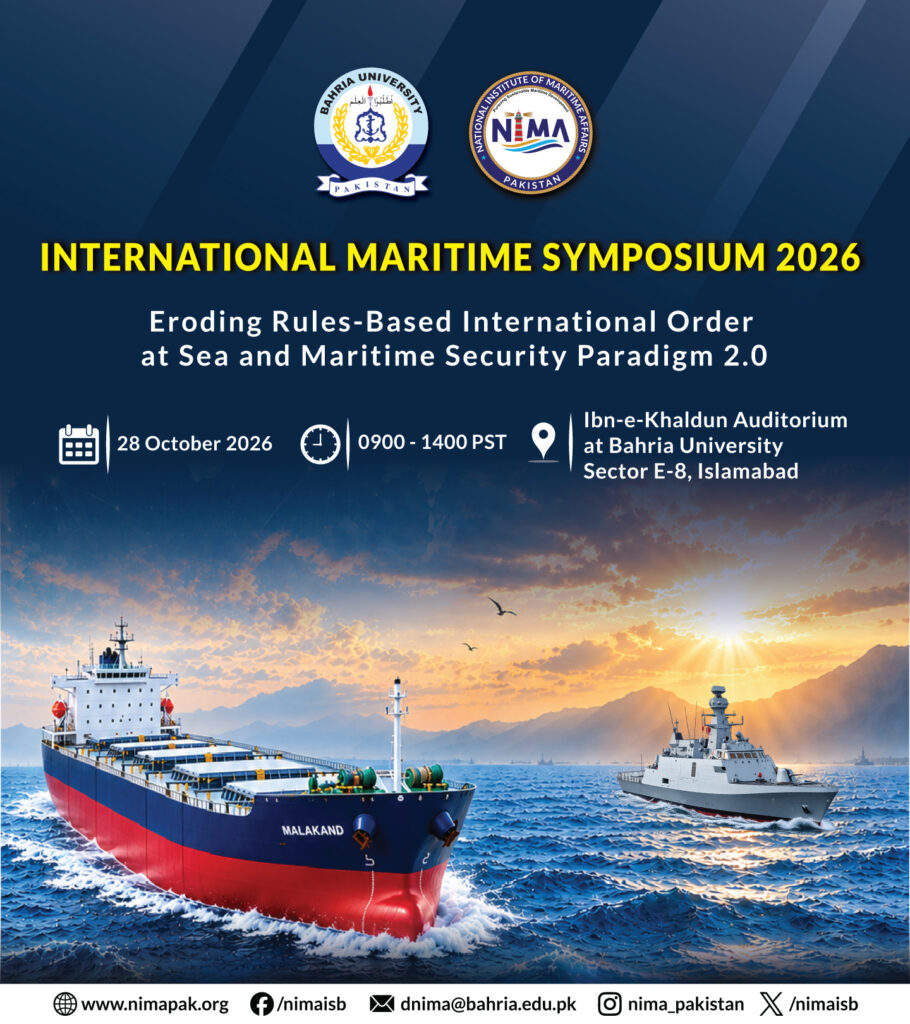
International Maritime Symposium-2026 is therefore aimed to generate policy-oriented analysis and practical recommendations that advance rules-based, sustainable, and inclusive ocean governance at national, regional, and global levels, while supporting Pakistan’s strategic maritime interests.