POST US/ISRAEL/IRAN WAR
PEACE & ECONOMIC DIVIDENDS FOR PAKISTAN
BLUE ECONOMY PATHWAYS TO RESILIENCE
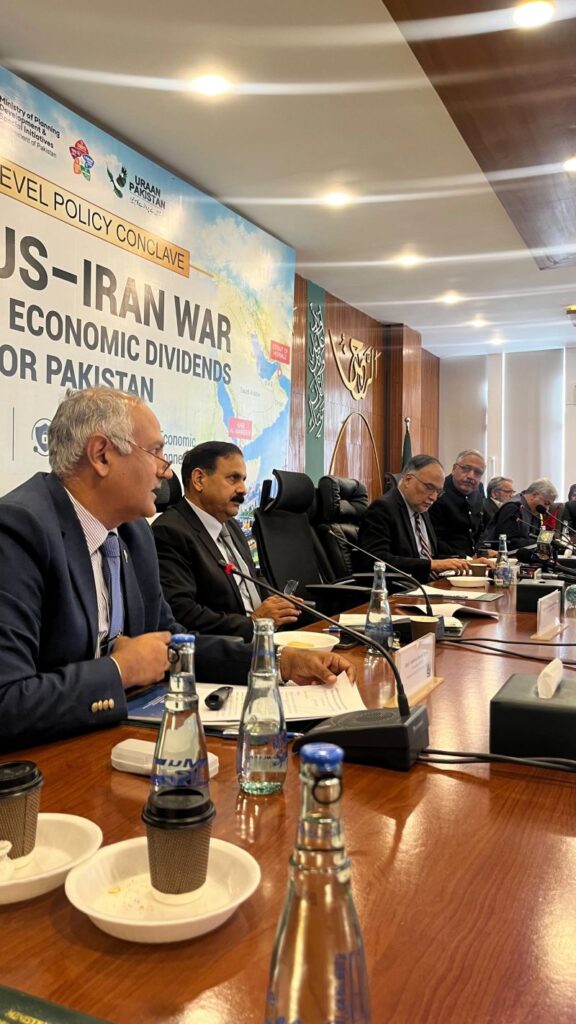
(Talk by Rear Admiral Javaid Iqbal Retd, President NIMA delivered at High Level Policy Conclave organized
by Ministry of Planning Development & Special Initiatives on 21 October 2026)
1. Honourable Federal Minister for Planning & Development Mr Ahsan Iqbal, General Zubair Hayat NI(M) former CJCSC, distinguished guests, ladies & Gentlemen. At the outset let me commend the policy makers at Ministry of Planning & Development, who in coordination with other stakeholders handle country’s economic security, which sits at the heart of national security. As someone said, when an organization is in doldrums the direction is more important than speed. That’s where the importance of Planning Commission comes in. Because as the maxim goes, failing to plan is basically planning to fail.
2. Given that our entire immediate neighbourhood to the west is up in flames and sending economic shocks worldwide, and given speculations that Pakistan already facing economic pressure may also be military sucked in, what are options for Pakistan? I will take up the national security and maritime economy lenz.
3. First things first. There is no defence without public support. And there is no public support without a functioning economy. In the words of Bill Clinton, “It’s the economy, stupid!” A thriving economy also ensures funding for a strong defence. From the international perspective as well, a country with a strong economy has more international stakeholders, and that lowers the possibility of an international armed conflict. It’s the new trinity of geo-economic national security. You may call it as Maarka-e-Maeeshat or Charter of Economy, and it is one and the same thing. As long as we have consensus that ‘It’s the economy, Stupid!’, it’s good. Here I am talking about the broad national consensus, of treasury and the opposition, of clergy and the liberal, of literate and the illiterate, of far right and the far left etc. It is our only path to salvation.
4. Also, I am glad that specially after the Hormuz went up in flames, everyone has started talking about importance of the maritime economy as a major component of national economy and the billions of dollars of missed maritime potential.
Thanks to speedy intervention by our Ministry of Maritime Affairs in relaxing rules for bonded warehouses and reducing port charges while offering incentives, we have been able to divert some of the transshipment cargo towards our ports. But the fundamental question remains that will this cargo diversion be sustainable in the long run, which is only the bread crumbs if we compare to what Jebel e Ali has been handling since decades. The promise of Gwadar awaits to be realized. The answer ladies and gentlemen is that we have to set the fundamentals right. Coastlines world over are called as engines of growth in any coastal country where efficient ports can be set up, cheap imports can be brought in the attached special industrial and economic zones, added value and re-exported to gain foreign exchange. Where ports and shipping lines can be offered as an efficient service provider to other countries looking forward to handle their trans-shipment and transit trade. But we in Pakistan find comfort in the cliché of Sea Blindness that “doesn’t let us grow as a maritime nation”. “If only we could become more aware of the bounties of the sea”, the 1000 Kms coastline and blah blah! But like the wonder-struck kid watching the ‘emperor with no clothes’, I am afraid that we all are barking up the wrong tree! We are asking the wrong questions! That’s exactly why we are getting the wrong answers! Sea blindness is NOT the primary cause as to why we are not exploiting the full potential of the oceans! We do not suffer from sea blindness. We actually fail to bridge the “Knowing – Doing Gap”. We suffer from the “Smart Talk Trap” where “Organizations often mistake talking, planning, analyzing, and writing detailed reports for actual progress. Meetings and presentations frequently become substitutes for execution rather than catalysts for it”. Our national traits, lack of entrepreneurial culture and absence of a supporting eco system are the real culprit. Let me be a bit more candid.
5. The central thesis of Nobel prize winning book ‘Why Nations Fail’ highlights that a nation’s economic success or failure is not determined by its size, geography, coastline, entrepreneurship culture, literacy or even by the form of government — It is determined fundamentally by its institutions that are either inclusive or extractive in nature.
6. Inclusive institutions help create ecosystems in which businesses thrive. They help reduce the cost of doing business and enhance the ease of doing business. And here comes the right question that we should be asking ourselves today. What would it take to make our institutions inclusive? We need to demand, and I say again even at the risk of repetition, we must demand the ease of doing business and reduced cost of doing business. Rest we can leave to the entrepreneurship genius of our people sitting in this hall and beyond. To the members of our trade chambers businessmen and women I have to say this — If YOU can create success out of chaos, I am sure YOU will make miracles out of a business conducive environment.
7. The concept of an Eco system is based on Triple Helix model where Government, Industry and Academia work together to benefit from synergies. The government provides policy direction, continuity and targets. The Academia provides path breaking research while benefiting from CSR funds and research grants. The banks provide Finance to fund the startups. The industry and businesses benefit from the research. It’s a win-win-win for everyone!
8. Talking specifically about Blue Economy, Here is an example of European Union Blue Economy Portal that has integrated all stake-holders into one web. The EU has established a Blue Economy Observatory that collates all relevant news at one portal as a one stop shop segregating topics of interest, events scheduled, funding opportunities and publications etc. It also uploads an Annual Report on Blue Economy. Pakistan has also come up with a report on Blue Economy under Uraan Pakistan. It is an excellent document but a standalone one and not integrated with other things. EU also highlights success stories of blue economy as nothing succeeds like success.
9. Ladies & Gentlemen! I could go on and on but due to limit of allotted time must stop here. The objective of this strategic level discourse is not to paint a gloomy picture. It is only to highlight as to how we can also start punching according to our weight and harness full maritime potential. Many good things are taking place in our maritime sector at a rapid pace, however it is all leadership driven. Ministries of Maritime Affairs and Planning are undertaking a lot of initiatives. But these are not enough. Despite initiatives, it took us a global crisis of Hormuz proportions to realize that Pakistan’s ports could perform even better if we had configured them for trans-shipment and created more bonded warehouse space. If we could have attracted investment in oil & gas pipelines, coastal refineries and strategic oil reserves before Hormuz blockade struck, we could have swung the international oil trade in our favour permanently.
10. If we have one takeaway from Hormuz it is this. Sea Power is important for a coastal state. Because maritime instability is going to be permanent. Energy prices aren’t going to come down to pre-Hormuz era. Sea power is a lot more than ports and ships and trade and navy. It is the ability of a State to exploit the leverages of its coastal geography and turn it into phenomenal economic advantage. Sea power is also about assured connectivity with maritime & logistics networks and their resilience. Maritime chokepoints have always been instruments of strategic leverage and they are going to stay like that. It is up to Pakistan to exploit our leverage.
11. Pakistan’s Blue Economy’s contribution to national GDP currently hovers around 1 Billion Dollars i.e 0.4% to 1% of GDP, compared to 7–35% in Maldives, Norway, and the UAE. Pakistan’s estimated Blue Economy potential is 100 Billion Dollars a year i.e. 4 – 5 % of national GDP. Clearly we have to do a lot of catching up.
12. Suffice to say that geography is important, but it is not everything. It is just a leverage and unless we apply force on a lever, we cannot lift heavy loads. The force is what I call facilitation to the maritime sector industry and entrepreneurs.
13. Consider this! Despite fuel shortages in the country, we aren’t able to bring in VLCCs due to depth limitations in our ports, and neither on SPM due to bottlenecks in our pipelines infrastructure.
14. Understand this too. World’s busiest and most efficient port is in Singapore. They have 190 Kms coastline and only one major port. They are sitting astride Malacca straits. Pakistan has 5 times the coastline. We have 3 major ports and potential to build more. We are also sitting astride Hormuz. Yet the data of containers handled last year tells the story. Singapore handled 45 Million TEUs where as Karachi handled 2.65 Million TEUs.
15. Remember, Its Blue Economy later but Knowledge-Economy first! Only those who use knowledge of the market to become more efficient will thrive. Blue economy is like any other competitive blood sports. Being an international business, inefficiency is a cardinal sin. If you do not perform, you will be wiped out. Unfortunately, Pakistan has not been efficient in fully harnessing the bounties of the sea.
16. The Gwadar Free Zone with a renewed CPEC 2.0 is still waiting to take off. If we don’t capitalize the Hormuz disruption, I doubt we will ever again.
17. Take example of Shipping Line. It is said that PNSC lift capacity is not sufficient and in order to reduce 6 Billion dollars freight charges we have to have more ships. It’s a no brainer! A country doesn’t even need a coastline to build a shipping line. The world’s largest shipping company is MSC or Mediterranean Shipping Company. It is doing global business and earning profit worth billions of dollars. And it is incorporated in a landlocked country, Switzerland! Let me tweak the Clinton saying a little, “It’s Knowledge-Economy, Stupid!”
18. Let us come to the issue of Supply Chain Cost. You already know that transporting goods on the sea is the cheapest mode followed by rivers, roads, railway and air. We have elaborate railway link and river system yet 90 % of our freight from Karachi to up north and back flows via road, not even rail. The extensive river system could have been used to transport goods like China is doing from Shanghai through Yangtze river and now through Pinglu canal to connect South-Western China. One exporter in Islamabad recently told me that transportation cost of his export goods from Islamabad to Karachi is more than the transportation cost via sea from Karachi to Vietnam! Talk about using railways if not rivers! Talk about spatial planning and developing export led industries along the coast near ports than up north.
19. The fisheries and aqua culture sector have similar challenges. The business is in now value addition, aqua culture, deep sea fishing with modern trawlers, efficient cold chain and marine conservation. But we are slow to adapt. That’s why despite comparable fish exports with Vietnam in the 1980s, now we export worth 568 Million dollars whereas Vietnam exports 9-10 Billion dollars.
20. Forget everything. Marine and coastal tourism is low hanging fruit. So is green ship recycling.
21. The high end game is trade corridors linking Central Asia and Western China. The five years Action Plan 2025-29 accompanying CPEC 2.0 had clearly identified need to exploit Gwadar’s potential for connectivity with Central Asia and China. The progress is slow.
22. We have to remove bottlenecks. We have to become efficient. There is no other option. Let us move beyond statements of intent, and set clear responsibilities, realistic deadlines and the resources needed for implementation. Let us make the plans measurable and have a feedback loop of audit and accountability to keep track of plan’s progress. Let us stop here and let us Walk the Talk. Oceans are calling. Thank You.
Author can be reached at presidentnima@bahria.edu.pk and javaid_iq_bal@yahoo.com