An ancient axiom, “The land divides; the sea unites”, depicts the contribution of the oceans, in linking people, economies and nations throughout history. Geoffery Till’s four attributes of the sea: as a resource of food and energy, a medium for exchange of communication and ideas, transportation and dominion, also illustrates the significance of the oceans. However, this space is now dominated by strategic rivalry, disputed jurisdiction, grey-zone activities and coercion.
Mark Leonard, in his latest foreign affairs article, argues that the current US-led international order is more fragile than ever, contested, and therefore cannot be sustained, and is leading to deep uncertainty about the future of global governance. He even says that due to sever competition, the world may witness the absence of any order for some time. Leonard presents the approach of two contradictory groups; the one as the “architects,” who wish to restore that order with stronger institutions and universal rules, and the other as “artisans,” who accept fragmentation and focus on adaptation by flexible, pragmatic arrangements. The former represents the western intent lead by the USA, while the latter is associated with the non-western states with China as the leading state.
This uncertainty needs to be tackled especially at sea, where competition of interests, maritime disputes, strategic rivalries and dropping global consensus affect international security directly. Hence, the challenge is to build a maritime order which is flexible enough to uphold cooperation even amidst an increasing geopolitical fragmentation.
Despite the ramshackle condition of the international order, it has not completely disappeared. Subjective interpretation and inconsistent application of maritime law, grey-zone operations, and ineffective enforcement have made the working rule-based order very fragile. At the same time, competition among great powers is turning the seas into theatres of strategic competition. Maritime militias, coast guards, and similar non-naval entities are being used more to achieve strategic goals below the threshold of military confrontation.
Hence, the escalation of geopolitical competition on the seas underscores the need for the reorientation of the security as, Maritime Security Paradigm 2.0’. Yoshifumi Tanaka’s study about the law of divided oceans and the law of our common ocean presents a valid theoretical basis for this paradigm shift. The former corresponds to competing national interests, while the latter refers to safeguarding the interests of the ocean based on cooperation through international organizations and reciprocity. As increasing competition complicates maritime governance, the need to bring cooperation into the heart of maritime realm, as stated by Tanaka, is evident, given that enduring solutions to the maritime issues can only be found through collective action.
Moreover, the BBNJ Agreement which came into effect on January 17, 2026, poses the urgent for Maritime Security Paradigm 2.0, based on cooperation and mutual interests. Driven by the idea of Arvid Pardo to let ocean resources serve the common good of humanity, including underdeveloped states and countries without access to the sea, the agreement aims at achieving fair distribution of benefits and strengthening the capacity of the least developed countries. The implementation of the agreement will depend on how open the countries will be to the principles of Paradigm 2.0 and readiness to prioritize cooperation over their immediate interests. Given that the high seas are regarded as the common heritage of mankind under the law governing the seas and ocean-floor resources, the BBNJ Agreement stresses the importance of making cooperation the basis of maritime security and ensuring fair distribution of benefits from the oceans.
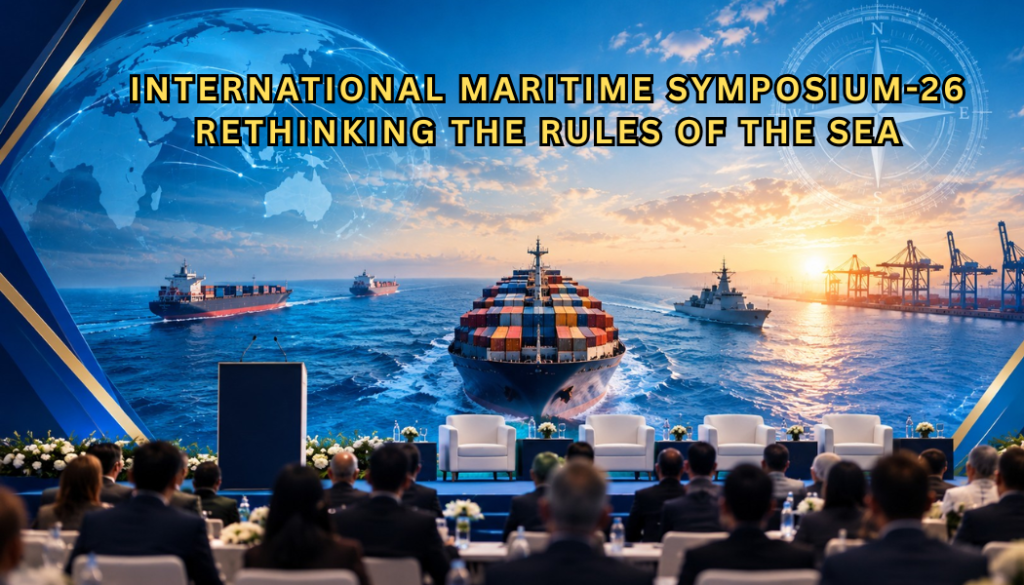
Given these dynamics, the National Institute of Maritime Affairs (NIMA) is organizing International Maritime Symposium (IMS-26) on 28th October 2026. The theme of this symposium is “Erosion of Rule-Based International Order at Sea and Maritime Security Paradigm 2.0”, which will enable discussion on the factors creating weakness in international maritime order and remedies to reinforce it.
This symposium is particularly significant for Pakistan. Its strategic location on the Arabian Sea has made it directly concerned about securing sea lines of communication and maintaining maritime stability. In addition, Pakistan is also concerned with the cooperative exploitation of seabed resources and is always interested in the positive developmental opportunities the BBNJ may provide, which is only possible by forging cooperation and minimizing the conflicts.
In a nutshell, IMS-26 aims to add a new dimension to the ongoing debate on curbing the erosion of maritime rules and reinforcing cooperative mechanisms. It is an endeavor to ensure that international maritime laws are implemented effectively, maritime domain awareness is enhanced, confidence-building measures in the regions are carried out, crisis communication is improved and vital maritime infrastructure is safeguarded. Finally, the objective is to keep the seas as a source of connecting rather than fighting, as a place of cooperation instead of compulsion, and as a source of proper development instead of geopolitical instability.
The Maritime Security Paradigm 2.0 should finally strengthen the system of rules and allow humans to take advantage of the great common heritage of mankind.
Author’s Bio
Nasir Imtiaz holds an MA in English Literature and Linguistics and an MPhil in International Relations. His research focuses on maritime geopolitics, great-power competition, the evolving global order, and strategic dynamics in the Indo-Pacific. His work examines contemporary geopolitical and maritime developments, particularly their strategic implications for Pakistan and the wider region. He can be reached at nasirimtiaz.nimaisb@bahria.edu.pk or nasirimtiaz78600@gmail.com.