A few days ago, a friend asked me a simple question: What, in your view, ails Pakistan’s maritime vision? It sounded straightforward, yet it carried the weight of an entire national mindset.
As I searched for an answer, my thoughts drifted to a phrase that is frequently repeated with proud exaggeration:
“Jinne Lahore nai vekhya, oh jamya hi nai,”
that is to say, whoever has not seen Lahore has not truly lived. Punjab, home to more than half of Pakistan’s people, is indeed the demographic and political engine of the country. For many, Lahore is not just a city but a symbol of heritage, culture, poetry, food, and unshakable optimism.
But the phrase does something subtle and unintended. While celebrating one’s origin, it quietly pushes others into the shadows. In the national imagination shaped by such hyperbolic pride, the sea, the coastline, and maritime life become mere footnotes. Fishermen’s songs, coastal festivals, ports, and ships seldom find a place in our collective story. The ocean remains peripheral to how Pakistan sees itself.
And that, I realized, is precisely what ails our maritime domain.
A Nation Mentally Far from the Sea
The irony is striking. Nearly three-quarters of the Earth is covered by seawater. Oceans are the largest living ecosystem on the planet and the primary engine of life. Yet for most Pakistanis, the sea remains a distant horizon, both physically apart and mentally remote.
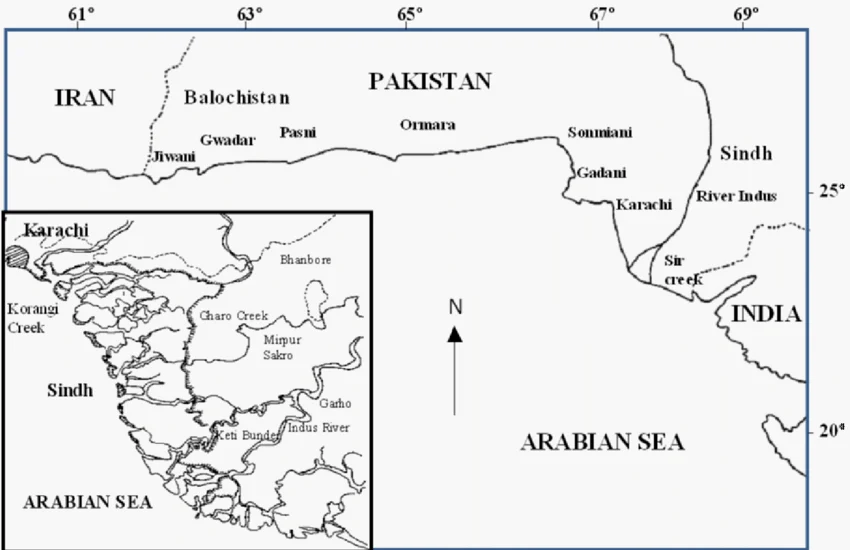
Globally, almost 40 percent of humanity lives within 60 miles of a coastline. In Pakistan, around 8 percent of the population resides along the coast. If Karachi is excluded, that number drops to 0.7 percent. Coastal towns such as Ormara, Pasni, Jiwani, and even Gwadar remain sparsely populated and economically underdeveloped. Even the neighborhoods hugging the Karachi shoreline carry their own stories of neglect.
This is not necessarily by design. Historically, the civilizations that nurtured us, the Indus Valley and Gandhara, grew along rivers, not along the coast. Our collective memory is riverine, not maritime. For centuries, we have been cradled by the Indus and its tributaries, not by waves and tides. As a result, for many Pakistanis, the sea remains an abstraction, rarely seen, scarcely felt, and poorly understood.
Why the Ocean Matters More Than We Think
The ocean sustains life on Earth in ways few appreciate. Phytoplankton floating on the sea surface produce nearly 50 percent of the oxygen we breathe while absorbing about 10 gigatons of CO2 every year. Oceans regulate global temperatures by absorbing sunlight and have absorbed more than 90 percent of the warming generated over the last fifty years. They generate weather systems, shape climates, and quietly keep the planet habitable.
The sea is also a crucial source of nutrition. Seafood provides around 16 percent of the world’s animal protein. Marine resources supply essential nutrients such as iodine, magnesium, and calcium. Astonishingly, more than 91 percent of marine species remain undiscovered, reminding us how little we truly know about this vast world.
The ocean’s economic dimension is equally immense. Over three billion people worldwide depend on seas and coasts for their livelihoods. The global blue economy, including shipping, fisheries, tourism, offshore energy, and ecosystem services, is estimated at between US$3 trillion and US$6 trillion annually. Fisheries and aquaculture alone generate about US$100 billion every year and provide employment to roughly 260 million people.
From climate regulation to food security, from medicine to employment, the ocean is a lifeline for billions.
Pakistan’s Profound Maritime Paradox
Here lies Pakistan’s deepest contradiction.
Our national gaze remains fixed stubbornly on land, yet more than 95 percent of our trade flows through the Arabian Sea. Economically we function like an island nation, but psychologically we behave like a landlocked one.
The Arabian Sea, part of the larger Indian Ocean, is among the busiest maritime corridors of the world. It carries nearly half of global container traffic and two-thirds of the world’s energy shipments. Around 100,000 ships pass through these waters every year, transporting goods worth over US$5.3 trillion.
Pakistan sits at a remarkable crossroads: close to the Strait of Hormuz, anecdotal Ali Baba’s cove and the proverbial jugular vein of global oil supply, and within reach of Bab-al-Mandeb, two of the world’s most critical maritime choke points. These narrow passages are to the sea what mountain passes are to land, small in size but enormous in strategic value. To the west lie energy-rich Middle Eastern states; to our east, the energy-hungry giants like China, Japan, India, and South Korea.
Few countries enjoy such a geostrategic maritime location. Yet geography benefits only those who think geographically. And we, as a nation, rarely think about the sea.
An Island Nation That Thinks Like a Landlocked One
Given our river-bound imagination, it is easy to forget that Pakistan’s true lifeline flows through the open waters, the Sea Lines of Communication (SLOCs) of the Arabian Sea. On the map, the sea sits at the bottom. Unfortunately, it also sits at the bottom of our thoughts and societal dialogues.
Consider the facts. Karachi Port alone handles around 1,600 ships annually. Port Qasim is expanding. Gwadar, the buckle of China’s Belt and Road Initiative, can accommodate large vessels and holds enormous promise. Yet the Pakistan National Shipping Corporation carries only about 16 percent of our seaborne trade. We remain overwhelmingly dependent on foreign shipping lines and external maritime services.
Our maritime exclusive economic zone, larger than Balochistan, Pakistan’s biggest province, could rightly be called Pakistan’s “fifth province.” Yet this enormous space of opportunity receives a fraction of the attention devoted to highways, metros, and real-estate schemes.
As a society, we remain sea-blind or at best cataract-visioned about maritime issues. And this blindness is perhaps the greatest ailment of all.
A Conceptual, Not Just Infrastructural Problem
Pakistan’s maritime problems are often discussed in terms of ports, ships, and infrastructure. But I believe the real issue is conceptual.
The ailment lies in a chronic lack of maritime awareness. The sea has no political constituency. Coastal communities are small and scattered. Maritime professions are little understood, and the stories of the sea rarely enter our classrooms, media, or cultural narratives.
Awareness will grow only when education, media, community action, and policy work together: when schoolbooks speak of oceans, when television highlights maritime heritage, when universities invest in marine sciences, and when policymakers recognize the blue economy as central to national prosperity.
The sea must enter our everyday conversations, our festivals, our films, our textbooks, and our dreams.
Time to Shift the Gaze
It is time we turn our gaze.
Pakistan’s fate is not tied only to its rivers and roads but equally to its shores and sea frontiers. Prosperity will not arrive solely through motorways and industrial zones but also through SLOCs.
We need to turn our gaze to the bottom of the map and rediscover the ocean that quietly sustains us. Only when Pakistanis learn to see beyond the comfort of rivers and plains, embrace the vast maritime world to the south, and weave the sea into their national story will the country truly think like a maritime nation. To conclude, if one has not realized the sea and its potential, then even a visit to Lahore cannot make life complete.