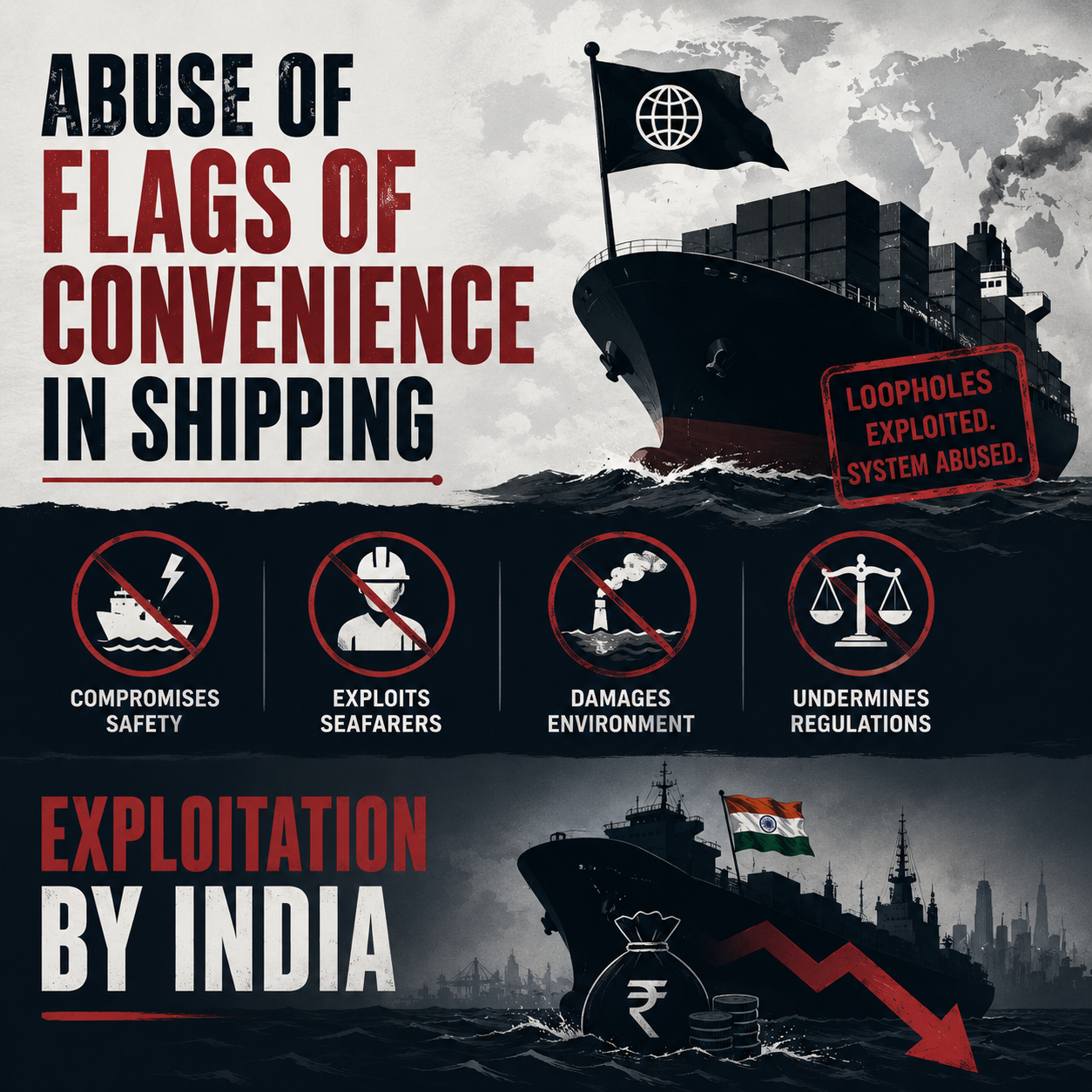
An attack by the U.S. Navy in the Gulf of Oman on the Palau-flagged oil tanker M/T Settebello has once again laid bare a deep inherent vulnerability and glaring weakness in international maritime law. While this harrowing incident—which left three out of twenty-four Indian seafarers dead and others in critical condition—is a matter of profound grief and shock, it also serves as a textbook example of the worst institutional exploitation embedded within the global shipping industry’s ‘Flag of Convenience’ (FOC) system.
The entire operational and administrative matrix of this vessel is shrouded in ambiguity. Its true ownership remains unknown. The vessel flew the flag of Palau (a tiny island nation in the Pacific Ocean); its crew comprised twenty-four Indian seafarers; and its cargo consisted of allegedly smuggled Iranian oil being transported despite stringent American sanctions. Its final destination? Unknown, the military authorities chosed not to disclose it. However True Operator / Beneficial Owner is Global Tankers Private Limited, which operates directly out of offices in Chandigarh and Delhi, India. The company is controlled by Jugwinder Singh Brar, a businessman blacklisted by the US Treasury for managing a “shadow fleet” transporting sanctioned Iranian crude.
States like Palau have zero commercial or maritime footprint, nor do they possess actual merchant fleets. For a nominal registration fee, they happily lend their national flag to virtually any vessel, after which these ships frequently become the primary instruments for illicit, unregulated, or highly suspicious global activities.
The United Nations Convention on the Law of the Sea (UNCLOS) explicitly enshrines the ‘Genuine Link Principle’ under Article 91. This foundational principle dictates that every state must fix the conditions for the grant of its nationality to ships, for the registration of ships in its territory, and for the right to fly its flag. Crucially, there must exist a genuine administrative, ownership, and operational link between the State and the ship. In other words, there must be a tangible legal or physical nexus connecting the ship’s owner, manager, or crew to the flag state. The situation described above is not just a blatant violation of international law, but an open mockery of the United Nations framework altogether.
Amidst this broader landscape, what is deeply troubling and fraught with contradiction is the diplomatic behavior of New Delhi. The Indian government vehemently condemned the recent attack on the vessel, summoned the relevant diplomatic channels, and deployed unusually harsh, securitized rhetoric. Yet, it conveniently deflected the foundational question: Why were Indian seafarers even operating on a vessel carrying sanctioned Iranian oil in the first place?
This is by no means an isolated incident. Lest we forget, in April, when the Iranian Islamic Revolutionary Guard Corps (IRGC) fired upon two Indian-flagged vessels in the Strait of Hormuz, New Delhi immediately summoned the Iranian ambassador, lodging a formal and severe protest. Yet, when dealing with the United States in this current crisis, that same diplomatic assertiveness completely evaporated into hesitant compliance.
This double standard clearly demonstrates how India is actively capitalizing on this global ‘Shadow Fleet’ network, leveraging it to facilitate the transit of sanctioned oil despite international embargoes. Following the U.S. administration’s tightening of oil sanctions against Iran—which triggered a sharp drop in Iran’s legal oil exports—massive economic companies in India have been covertly purchasing this oil. They exploit the ‘Flag of Convenience’ system as a fraudulent security shield to bypass international sanctions, rendering a mockery of both international law and global morality.
Although the Indian political opposition is putting immense pressure on its government, openly challenging it for failing to confront the United States, the harsh reality remains: India itself is a major stakeholder and partner in this deceptive and shady maritime trade. Until New Delhi formulates concrete, unyielding policies to prevent its seafarers from being deployed on such hazardous, obsolete, and legally compromised vessels, these disadvantaged seafarers will continue to be used as mere pawns in this highly expensive, dangerous geopolitical game.
While the International Maritime Organization (IMO) has formally condemned these recent actions for putting maritime safety at grave risk, mere condemnation from international bodies is no longer enough. The current crisis demands deep, sweeping structural reforms. The traditional system of ‘Flags of Convenience’ must either be dismantled entirely, or flag state laws must be made so stringent that no state can disavow legal responsibility for a vessel’s true identity, ownership, and operational conduct.
This tragic event serves as a serious food for thought for the international community at large, and the Indian public in particular. The families of the deceased seafarers are currently not only mourning and anxious for the safety of their loved ones, but they are rightfully demanding answers from their government: Why were their relatives pushed into the jaws of death on a fake, chartered, and sanction-busting vessel?