- On the historic occasion of the 75th anniversary of establishing diplomatic relations, I take stock of the past, present and future of China-Pakistan Maritime Cooperation.
- I begin by a quotation from President Xi Jinping. He said in 2019 and I quote, “The ocean does not separate our blue planet into isolated continents; Instead, it links the people of all countries to form a global community of shared future that remains bound together through thick and thin.”
- Thus set in a largely maritime context, China’s Belt and Road Initiative aims to build an interdependent, peaceful and prosperous world. This is a grand strategic idea that rejects the notion of mutually destructive Zero-Sum competition and promotes mutually progressive Win-Win cooperation that is indeed novel in modern history.
- Given more than 70% of our planet is covered by oceans, and by corollary more than 70% of planet’s resources are also found in the seas, and given the freedom of the high seas and as a conduit and enabler of more than 85% of the global trade that is seaborne, the oceans are and will increasingly be central to China’s main effort of building a global community with shared future.
- Having set the big picture, I will now state the Bottom Line Up Front. Successful China-Pakistan Maritime Cooperation is a Strategic Imperative for the success of Belt & Road Initiative aimed at building a global community with shared future. This is different! It goes beyond even the CPEC. Let me say it again even at the risk of repetition. Successful China-Pakistan Maritime Cooperation is a Strategic Imperative for the success of Belt & Road Initiative aimed at building a global community with shared future. That’s the punchline!
- In fact the operationalization of China-Pakistan All-Weather Strategic Cooperative Partnership and success of CPEC as enabler of BRI is incomplete without realizing the full potential of its maritime dimension that remains the lynchpin.
- Let me emphasize that the maritime dimension comprises not only Gwadar, which is a given, but the entire Pakistani coastline straddling 1001 KMs that can act as a growth engine and a springboard for BRI athwart the most important global maritime commons emanating from chokepoints of Hormuz and Bab al Mandab, and linking the Straits of Malacca.
- This is the strategic maritime space that will determine the future of the ongoing strategic great power competition. And China-Pakistan maritime cooperation is destined to play a central role in it. The Hormuz blockade has vindicated this assertion. This is what being a ‘prisoner of geography’ means!
- The new great game of the 21st century is being played out at the oceans, from Panama to Malacca, and from Hormuz to Arctic, somewhere in the form of so called “Indo-Pacific” strategy, which is in fact a misnomer, correct name being Asia-Pacific. And somewhere in the form of articulating a Rules Based Order while willfully undermining it. And it is here that the defences of peace through building a community of shared future are being articulated by China. Not as a Great Wall to stop adversaries, but as a Great trans-oceanic Bridge connecting people, which when fully operationalized will be remembered by posterity as a 21st century Chinese miracle.
- A quick overview of the China-Pakistan maritime cooperation recalls tremendous progress and many firsts. Karachi was the first ever foreign port visited by modern Chinese PLA Navy warships in 1985. Similarly Pakistani warships were the first ever foreign warships that called on a Chinese port in 1985. The first ever naval exercise by Chinese PLA Navy with any foreign navy was with Pakistan Navy in 2003. Similarly the technical cooperation has come a long way since induction of Chinese hydrofoils and gunboats to joint production of most modern Hangor class submarines today. However, an equal pace in the maritime cooperation which is a far bigger canvass and strategic impact than naval collaboration leaves much to be desired, given the potential of a 1001 kilometers BRI launch pad from coastal Pakistan.
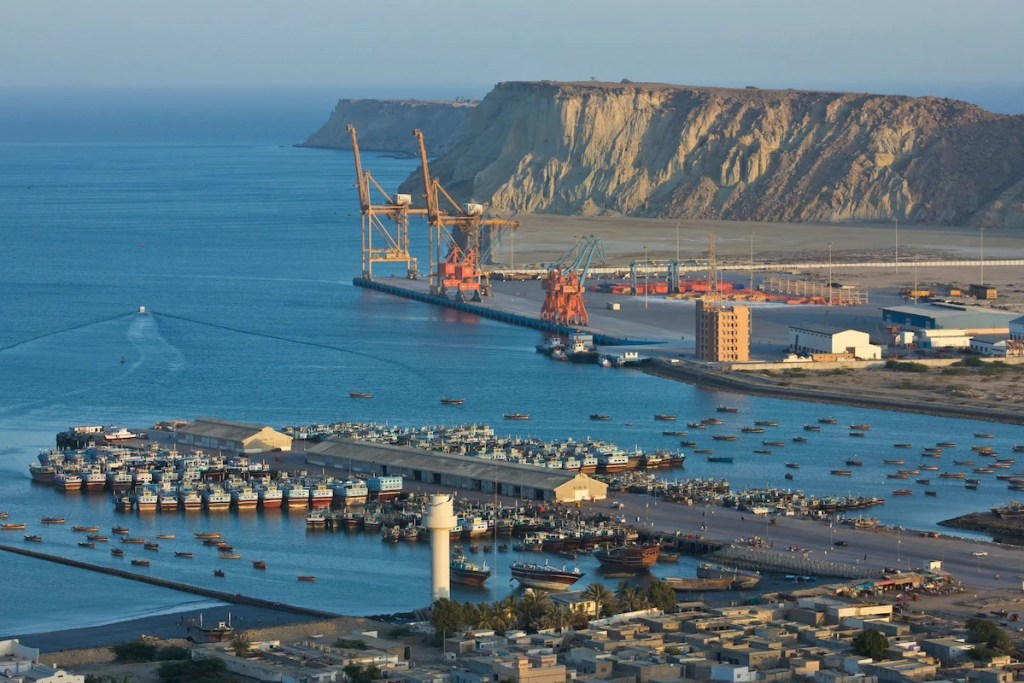
- The visualization of this pivotal role over next 25 years also calls for a reality check. Let us visualize Gwadar of 25 years ago, when the agreement for developing a deep water port was signed in 2001 and groundbreaking done in 2002. Almost 25 years down the lane, the full potential of Gwadar is yet to be realized. We may be getting there but the pace is slow. Had the hinterland connectivity of Gwadar port been fully developed by now, and had the port been visualized and enabled as a real deep water transshipment port, it would have reaped the real bounty post Hormuz shutdown rather than receiving trickle diversions. The pivotal importance of Gwadar to the BRI can be gauged not by its economic projections, but by the negative propaganda that it receives at the hands of Western and Indian press framing it in military colours. But the fault isn’t entirely theirs! The fact that Gwadar was conceived and built as a purely commercial port is belied on the ground by the pace of its commercial development. A breakwater so necessary for development of phase-2 of the port remains in the waiting despite assured funding. So is the case with a planned shipyard necessary for a bustling port. The Free Zone too is gathering headway at a slow pace. But the recent episode of a Chinese company struggling to export meat from Gwadar tells a different story. Make no mistake! The ball is squarely in our court. The question is … Are we willing to play the ball? Our collective response will determine the course of next 25 years of China-Pakistan maritime cooperation, that is, I say again, a Strategic Imperative for the success of Belt & Road Initiative aimed at building a global community with shared future. Lets make it so.
- Before I close, let me share a template for next 25 years of maritime cooperation which is not exhaustive.
- Immediate Timeframe (by 2030) – Gwadar emerges as a trans-shipment port with COSCO making it as major Hub Port, Maritime scholarships on the pattern of agricultural scholarships for Pakistani scholars from coastal communities, thriving coastal tourism, construction of breakwater and shipyard at Gwadar, transformation of PNSC as a major shipping line, revival of shipbreaking industry, transformation of Marine Academy as a Maritime University, Reviving fishing harbours and cold chain/value addition, Exploration of deep sea fishing potential, ML-1 revival … In a nutshell, we must fully implement the Action Plan 2025-2029 to build a China-Pakistan community with a shared future with even stronger political mutual trust, closer economic and trade ties, deeper security cooperation and a more solid popular basis, which will serve as a model for the building of a community with a shared future with neighboring countries. China Pakistan Maritime cooperation will therefore set the stage for China’s global maritime cooperation.
- Mid-Term (by 2040) – Gwadar port hinterland linkages fully developed including rail connectivity, Maritime Energy City on coast fully operational with strategic crude & petroleum reserves and refineries, offshore wind energy production in place …
- Long Term (by 2050) – Offshore oil rigs functional and deep sea mining potential being harnessed …
- I could have gone on and on but for the paucity of allocated time I close in the words of President Xi Jinping again, “Let us build a maritime community of shared interests”.
- Thank you!