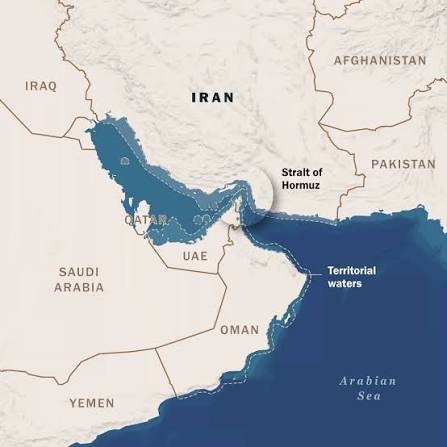
The recent United States–Iran Memorandum of Understanding (MOU) on the Strait of Hormuz has been widely viewed as a diplomatic step to prevent another regional crisis. While the agreement guarantees the safe passage of commercial vessels and encourages future dialogue, its real significance extends far beyond de-escalation. It signals the beginning of a larger contest over who will govern one of the world’s most strategic maritime chokepoints and, by extension, who will shape the future rules of the sea.
The Strait of Hormuz is often described as the world’s most important energy corridor. Nearly one-fifth of global oil and liquefied natural gas exports pass through its narrow waters. Any disruption immediately reverberates through international markets. Yet the emerging debate is no longer about whether the Strait will be closed. Such a move would damage Iran’s own economy as much as anyone else’s. The real question is who will exercise greater authority over the Strait’s management while keeping it open.
For more than four decades, the United Nations Convention on the Law of the Sea (UNCLOS) has provided the legal framework for international straits. It guarantees the right of transit passage, allowing ships and aircraft to move freely through strategic waterways while recognizing the sovereignty of coastal states over their territorial seas. This balance has been one of the foundations of global maritime stability.
Today, however, that balance is being tested.
China has already demonstrated how international law can be interpreted through the lens of national security. In the Taiwan Strait, Beijing does not reject navigation rights. Instead, it argues that these rights must be exercised in a manner consistent with China’s sovereignty and security interests. This approach shifts the focus from unrestricted access to regulated access without formally departing from international law.
Iran may adopt a similar model in Hormuz. Rather than restricting commercial shipping, Tehran could gradually expand its operational authority through enhanced vessel reporting, maritime traffic management, coordinated security arrangements, and closer cooperation with Oman and other Gulf littoral states. Navigation would continue, but regional states would assume greater responsibility for administering the Strait.
Such a development would not necessarily violate UNCLOS. The Convention permits coastal states to adopt measures relating to navigation safety, environmental protection, and maritime security, provided they do not hamper transit passage. This legal flexibility creates space for competing interpretations. The United States views transit passage as allowing the normal movement of military vessels and aircraft through international straits. Iran and China argue that activities threatening coastal-state security fall outside those protections. The dispute, therefore, is not over the existence of international law but over its interpretation.
The recent MOU reflects this evolving reality. While ensuring uninterrupted commercial navigation, it also opens discussions on the future administration of the Strait involving Iran, Oman, and other Gulf states. This suggests that maritime governance in Hormuz may increasingly be shaped by regional arrangements rather than by extra-regional powers alone.
This shift highlights a deeper contradiction within UNCLOS itself. The Convention is largely founded on the principle of Mare Liberum, the idea that the oceans are a global common open to all. At the same time, it recognizes territorial seas, exclusive economic zones, and extensive coastal-state jurisdiction, reflecting elements of Mare Clausum. In other words, UNCLOS simultaneously promotes openness and exclusivity. As geopolitical competition intensifies, states are increasingly emphasizing one principle over the other to advance their strategic interests.
The debate is further complicated by the fact that security itself is not an objective or fixed concept. As Ken Booth argues, security is one of the most powerful political terms because what states define as a security issue, often shapes their policies more than the actual level of threat. Building on this idea, Ole Wæver’s theory of securitization explains that issues become matters of security through political discourse. By portraying an issue as an existential threat, political leaders justify extraordinary measures that would otherwise be difficult to defend. In strategic waterways such as the Strait of Hormuz, competing interpretations of maritime security therefore become instruments of statecraft. The question is no longer simply what international law permits, but who has the authority to define what constitutes a security threat.
The Strait of Hormuz has become the clearest example of this dynamic. Coastal states increasingly frame maritime activities through the language of national security, while major naval powers continue to defend freedom of navigation as a global public good. The result is a growing process of securitization in which legal rights are interpreted through competing security narratives. Increasingly, the contest is shifting from military confrontation to legal interpretation and institutional influence. In this emerging order, whoever shapes the meaning of security may ultimately exercise greater strategic leverage than whoever deploys the largest naval fleet.
For Washington, this represents a gradual strategic challenge. American maritime dominance has long depended on preserving open access to global sea lanes under a liberal interpretation of UNCLOS. If regional powers begin assuming greater responsibility for governing strategic chokepoints, even within the Convention’s legal framework, the centre of maritime authority will slowly become more diffuse. This does not signify the decline of American naval power, but it does reflect the emergence of a more multipolar maritime order. Robert D. Kaplan warns that the gradual erosion of U.S. naval dominance will make it increasingly difficult for Washington to preserve its preferred interpretation of the rules-based maritime order in strategically important chokepoints such as the Strait of Hormuz.
The Strait of Hormuz is therefore no longer simply an energy corridor. It has become a testing ground for the future of global maritime governance. The recent MOU demonstrates that the contest is moving beyond military deterrence towards competing interpretations of sovereignty, security, and international law. The central question is no longer whether ships will pass through Hormuz. It is who will define the rules under which they pass.
The answer will shape not only the future of the Gulf but also the future of the international maritime order.