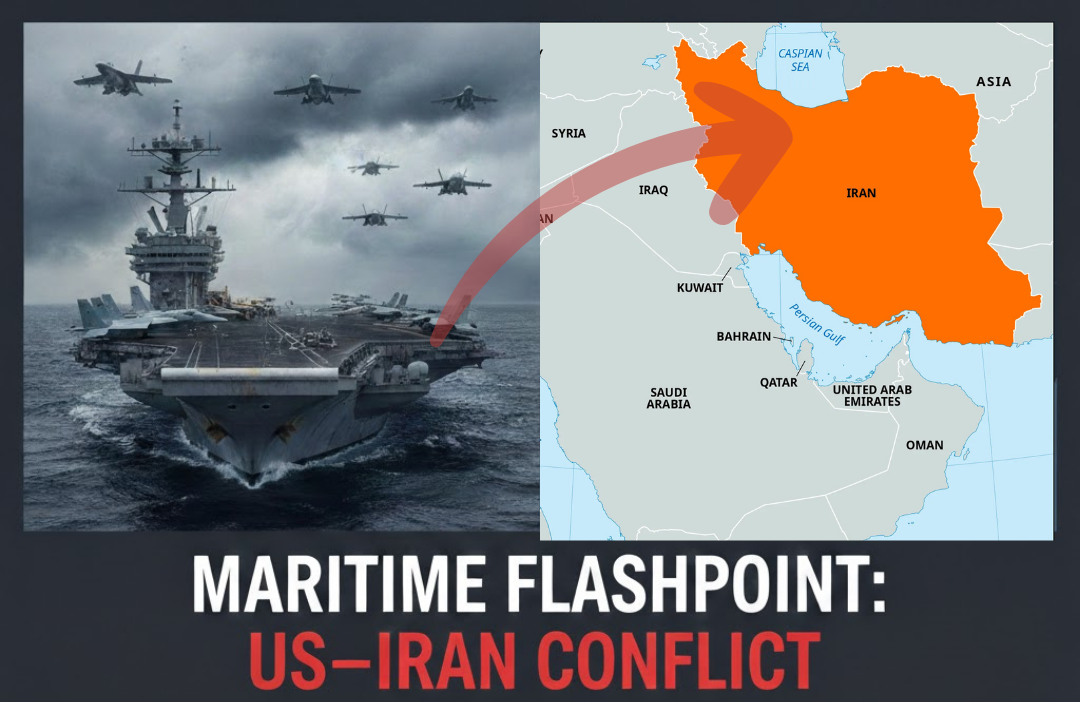
The present conflict between United States and Iran is not solely a political issue. Rather, it has the potential to turn out to be one of the geopolitical hotspots of this decade. The present reported increasing instability within Iran, alongside the increased risk of tensions with the United States, which has the potential to culminate into an actual limited war, does not only pose the danger to the peace of the region, but also to the energy security in the world, maritime trade, and the stability of the world economies.
Strait of Hormuz which is a narrow passage between Iran and Oman joins Persian Gulf to the Gulf of Oman and provides further outlet to the Arabian Sea. Although its width at the narrowest point is only 33 kilometers, it is among the most significant passages in the sea. It is of great relevance in the above context. It is the route through which approximately 20 million barrels of oil are transported per day which is approximately 20 percent of the daily oil consumption in the world. Over 80 percent of the crude oil and LPG that is passed through Hormuz is destined to Asian market, such as China, India, Japan, and South Korea. In case this route is blocked even temporarily, then the world would have lost practically approximately a fifth of the world energy daily requirements, and this would obviously cause a monumental impact on the world markets.
USA has its very visible presence in the Middle East i.e. Qatar, Bahrain and Kuwait to name a few to ensure the security of the maritime trade routes. The Fifth Fleet which is headquartered in Bahrain has long been mandated with the role of safeguarding commercial shipping in the Hormuz and the Gulf. USA is also spearheading the Coalition Maritime Force (CMF) since almost two decades and thus has the military and naval wherewithal to control the maritime SLOCs and security.
Notwithstanding, Iran has its border all along the Persian Gulf. Thus, closing of Persian Gulf is not out of possibilities. Iran has even voted in parliament to approve the closing of the Straits of Hormuz to retaliate against the American military action though it would actually need the authorization of the Supreme National Security Council. Irrespective of its practicality, the mere threat alone creates a ripple effect in international market since all news of possible closure raises oil prices nearly instantly.
Impact of any obstruction to the Straits of Hormuz would be felt instantaneously. A complete shutdown could take the price of the Brent crude from present $60s to $110-130 or higher in the short run. Even partial slow-downs cause volatility in the prices. Shipping companies can close down or reroute tankers, increasing the transit time and costs. It is also possible to have a global trade slowdown since besides oil; the Strait also transports other goods and raw materials. A major sea accident or sinking of a ship deliberately or otherwise by any stakeholders would reduce the pace of the trade instantly, affect the stock markets and raise the prices of consumer products globally.
This puts Pakistan at a high risk due to the fact that almost 95 percent of its foreign trade passes through the Arabian Sea. Major shipping ports i.e. Karachi and Port Qasim depend on unhindered transit of trade along the Indian Ocean and the Persian Gulf maritime pathways. Disturbances or even the threat of it may cause a sharp rise in the price of fuel and electricity, higher costs of transport and production, and further inflation.
Pakistan thus needs to have a balanced and neutral policy. It cannot openly ally itself to one of the sides between the U.S. and Iran in order to safeguard trade and energy connections. The need to diversify energy sources is necessary. Some alternative oil suppliers that Pakistan can consider in the longer run could include Nigeria, Angola, or Brazil. These sources are not as close in geographical location as the Gulf, but they offer a backup in the event of a long term disruption. The reliance on a single volatile route is productive in peace but counterproductive in such situations. So a strategy needs to be devised while cognizant to the contemporary world dynamics.
Maritime security obviously need to be enhanced for Maritime Domain Awareness (MDA) and initiation of subsequent actions based on ground realties. It is also essential to communicate with regional states and maritime information & coordination centers in the region for updates to prevent panic and misinformation.
Overall, the US-Iran confrontation has the potential to jeopardize the core of the energy infrastructure in the world. Any form of disruption to Straits of Hormuz can cause tremors in the global economy and affect nations including Pakistan significantly. The worst-case scenario would be that oil prices would soar and trade would slack and costs of fuel, food and transport would increase to the ordinary people. Pakistan can mitigate such risks through neutrality, protection of maritime routes, assurance of energy supply and diplomacy. The Persian Gulf is thus the focus of the whole world. Finger crossed.