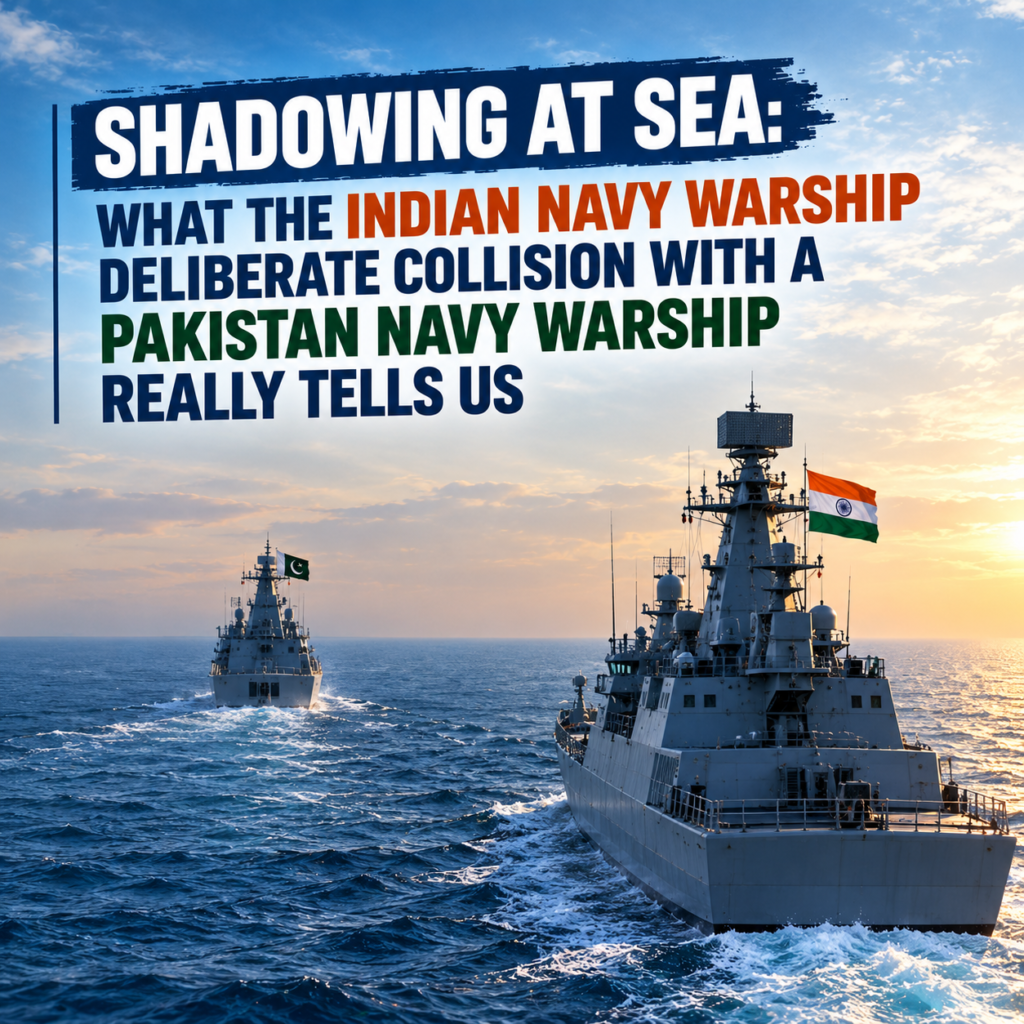
The collision between a Pakistan Navy and an Indian Navy warship in the North Arabian Sea on 15 Sep 26 merits to be seen as more than a navigational mishap. It occurred while the Pakistan Navy was conducting its biennial SEASPARK-26 exercise, and its naval assets were followed for several days by Indian Naval assets, close to the exercise area. In a region already marked by strategic mistrust, the incident illustrates how routine naval surveillance can develop into dangerous close-quarter interaction and how quickly a tactical encounter can acquire diplomatic and strategic consequences.
The official statement of the foreign office categorically states that while the Pakistan Navy was undertaking its biennial exercise SEASPARK-26, the Indian vessel carried out aggressive manoeuvres in dangerous proximity to a Pakistani naval ship, resulting in contact between the two vessels, which is a serious violation of international law and the bilateral agreement on Advance Notice on Military Exercises, Manoeuvres and Troops Movements, 1991. It urged India to adhere strictly to international law and bilateral agreements, particularly those aimed at preventing incidents at sea.
Pakistan Navy has been conducting SEASPARK-26 in Pakistan’s Exclusive Economic Zone (EEZ) since 01 Sep 26. It was a properly notified and scheduled exercise. Reportedly, since 07 Sep 26, an Indian naval vessel, with an embarked helicopter, had repeatedly attempted to enter the area in which the Pakistani exercise was conducted. Consequently, on 15 Sep 26, INS KOLKATA conducted aggressive and dangerous manoeuvres in proximity to PNS HUNAIN, eventually coming into contact. Fortunately, the incident caused no reported loss of life, injuries or serious damage. Nevertheless, the absence of casualties does not diminish its seriousness.
Pakistan subsequently summoned India’s Chargé d’Affaires and lodged a strong protest, describing the action as provocative and unacceptable. India, on the other hand, has presented the opposite account and said that the incident occurred in international waters and that PNS HUNAIN approached an Indian warship operating on a routine surveillance mission at high speed and in an unsafe manner. It’s obviously an Indian failed effort to recast the circumstances of the incident and shift responsibility by presenting a false /disputed version of events as fact.
There is an important operational point here. Naval shadowing is normal. Warships routinely monitor, track and shadow the naval forces of other countries, particularly during exercises, from a safe distance. The situation, however, changes when surveillance becomes persistent close-proximity shadowing. Indian warship presence in proximity to the exercise area since the onset is therefore significant. It suggests something more sustained than an incidental encounter. It is consistent with a deliberate surveillance and shadowing posture directed at disrupting the conduct of SEASPARK-26. The very value of maritime shadowing lies in proximity; the danger arises when that proximity becomes excessive. This is exactly the case here.
Let us first analyse the incident through legal instruments. UNCLOS 1982 provides the broader framework; the 1972 International Regulations for Preventing Collisions at Sea (COLREGs) provide the detailed navigational rules; the 1991 bilateral agreement provides an additional India-Pakistan confidence-building and separation mechanism; and the Code for Unplanned Encounters at Sea (CUES) is relevant as a comparative naval safety framework.
First, under UNCLOS, the high seas are subject to the freedom of navigation, but that freedom is to be exercised with due regard for the interests and rights of other States. Even, for argument’s sake, if the collision had occurred in international waters/high seas, that does not mean that the Indian warship was free to manoeuvre without regard to internationally recognised rules of navigation and collision avoidance. Under UNCLOS, flag States have duties relating to safety at sea. Indian warship actions were in deviation from the international norms.
The legal position requires precision. Pakistan’s reference to its forces operating in its EEZ implies that the Pakistan Navy was operating in its traditional area of operation, and although other states retain freedom of navigation, UNCLOS requires states exercising those freedoms to have “due regard” to the rights and duties of the coastal state, i.e. Pakistan. Irrespective of Indian warship presence in Pakistan’s EEZ, the more relevant question is whether its conduct while operating there was compatible with international law, navigational safety requirements and applicable bilateral arrangements. In this case, Indian warship actions were in total departure from normal.
The principal operational framework in this case is the 1972 International Regulations for Preventing Collisions at Sea (COLREGs). Its application is not dependent on whether the vessels are merchant ships or warships: Naval status does not remove the basic obligations of maintaining a proper lookout, proceeding at a safe speed and taking appropriate action to avoid collision. Its rules particularly stipulate addressing the assessment of collision risk and action to avoid collision. COLREGs thus constitute the principal technical collision-avoidance regime. These provisions are particularly significant where two warships are manoeuvring in proximity. Again, Indian warships did not adhere to safe practices as per COLREGs
Third, the Code for Unplanned Encounters at Sea (CUES) was developed within the Western Pacific Naval Symposium framework to reduce the possibility of incidents between naval forces through standardised communications, safety procedures and manoeuvring practices. It has since been adapted by the Indian Ocean Naval Symposium (IONS) of which both India and Pakistan are parties. Its principles illustrate an established regional naval practice: when warships unexpectedly encounter one another, professional communications, predictable manoeuvring, avoidance of provocative actions and clear signalling are intended to reduce miscalculation and escalation.
Fourth, and most specifically for India and Pakistan, is the 1991 Agreement on Advance Notice of Military Exercises, Manoeuvres and Troop Movements. Article 10 is particularly relevant. The provision establishes a three-nautical-mile separation between naval ships and submarines of the two countries operating in international waters, aimed at preventing accidents. The significance of Article 10 is that it potentially creates a more specific bilateral safety obligation than the general COLREG framework. In other words, even if the encounter took place beyond national maritime jurisdiction, India is still bound by their bilateral undertaking concerning the safety thereof.
Indian warship thus deviated from all the established safe practices and, in its pursuit, crossed the limits and contacted the Pakistani warship. Strategically, this is the most important aspect. In a stable maritime environment, strategic mistrust changes the meaning of proximity. A surveillance manoeuvre can be interpreted as provocation; an evasive manoeuvre can be interpreted as aggression; and a collision can rapidly become a political incident. Adherence to laid-down regulations is thus of utmost importance between Pakistan and India.
Overall, it was a callous and irresponsible action by the Indian Navy, void of legal construct and adherence to accepted international safe practices of navigation. These century-old practices of hitting ships into each other are medieval, to say the least and are not expected from any country in the contemporary realm. It is important that the safety of navigation at sea is adhered to by all, irrespective of their rivalries. Pakistan is doing so; we hope that India also behaves like a civilised nation and adheres to the same. Professionalism is the hallmark of mariners. Let it be so by all.
The incident may also be viewed as reflecting a broader false mindset of India in which it believes itself to be absolved of adherence to established legal and moral constraints by a responsible nation. Such an approach, if translated into maritime conduct, risks weakening adherence to international law, navigational safety rules and bilateral confidence-building arrangements.
Pakistan Navy’s response during Marka-e-Haq in May 26 testified to the fact that maritime power cannot be assessed by the size of individual platforms alone; rather, operational resolve, preparedness, situational awareness and the ability to respond effectively matter. The lesson should therefore not be reduced to a contest of platforms, it is that power at sea must remain coupled with discipline, law and responsible conduct.